
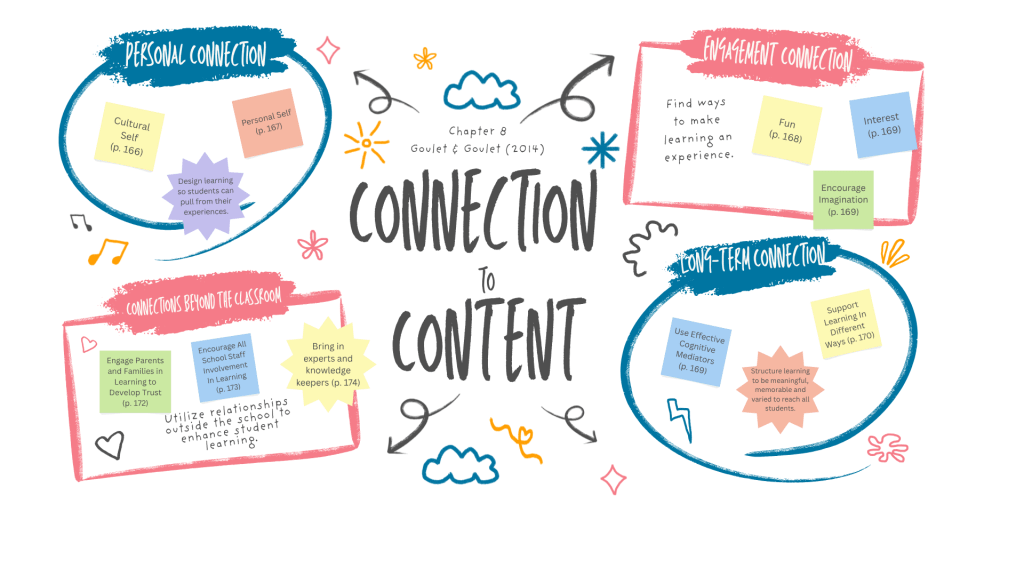
This past week, I reviewed chapter eight of Goulet & Goulet’s book: Teaching Each Other: Nehinuw Concepts & Indigenous Pedagogies (2014). As I scribbled my notes and ideas sporadically on my paper, I realized that I was creating a mind map that visually represented my understanding of Goulet & Goulet’s idea of connecting students to the content that they are learning. As an aid for this blog post, I created a digital version, as seen above. I will use cropped sections of this mind map below to help guide and discuss my understanding of connection to content.
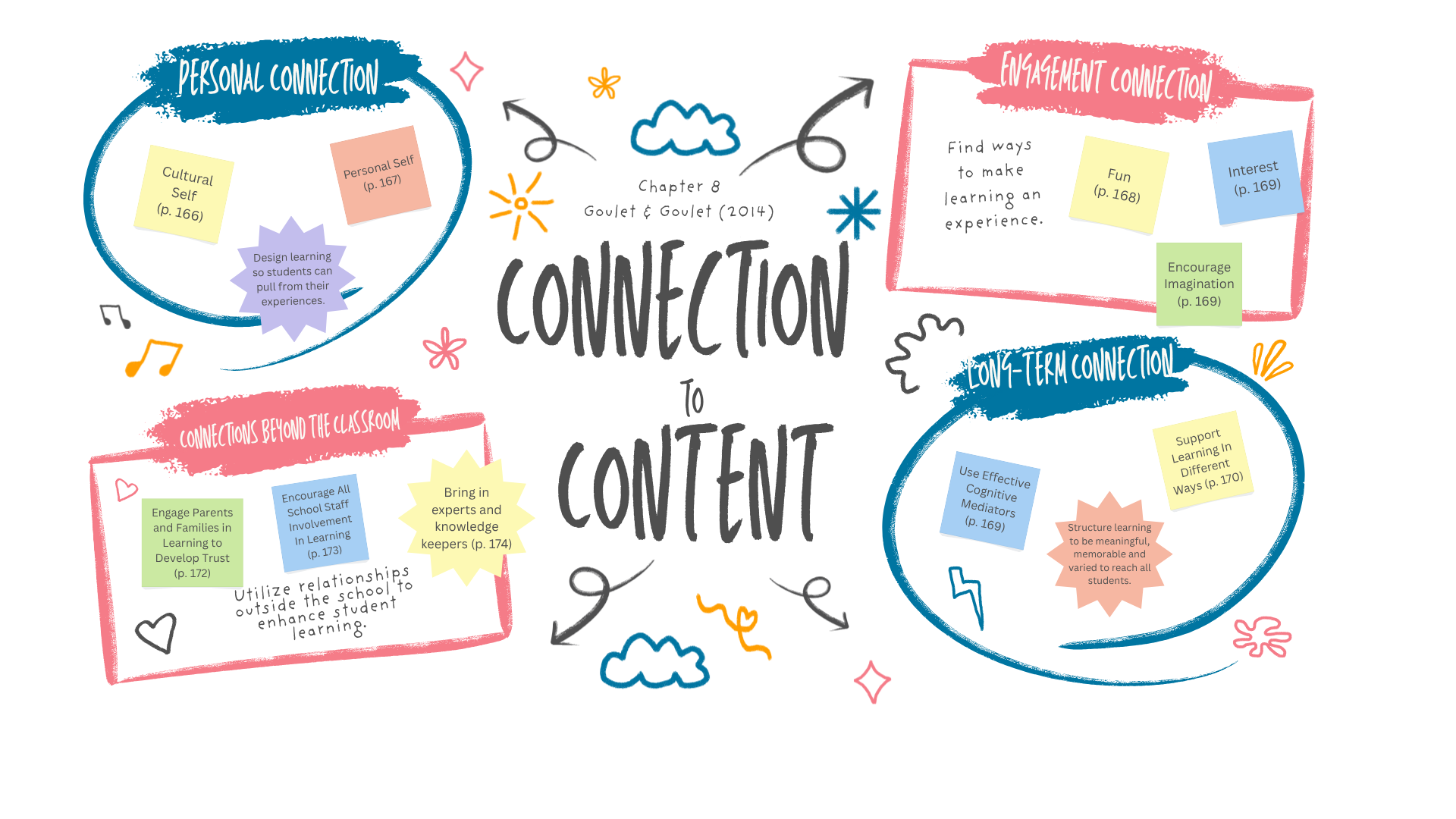
PERSONAL CONNECTION: Goulet & Goulet establish that in order to connect students, especially Indigenous students, to content, they need to see their personal self (p. 165) and cultural self (p. 166) embedded and represented in their learning. One of my favourite get-to-know-you activities at the beginning of the year is leading students through an extensive tell me about yourself inventory. I love to ask questions about what students like to do outside of school, who do they consider to be family, fun facts about themselves, some would you rather questions and end with information regarding reading, writing and other content areas. The reason that I choose to do this in a written format is to allow myself to obtain these answers for further planning. I recall once where a grade six student shared that they loved drumming. I remember altering my year plan to include a percussion unit and we even completed a bucket drumming performance for the school in the winter concert. Years later, when this student was in grade 11, I felt a sense of joy when I learned that this student went on to join a drumming circle in high school and even played at their high school graduation. I am aware that I did not lead that student to their drumming group; however, I know that I encouraged and valued their interest within the classroom which only helps to fuel students investment in an activity instead of discouraging or dismissing it.
Going forward, utilizing interest inventories to support planning and instruction is something I plan to continue. I would like to challenge my future self to utilize these interests and have students participate in shared leadership (p. 165) so they can teach their classmates about their passions.
As mentioned, Goulet & Goulet recognized that students need to see their cultural selves represented in learning (p. 166). I know that I need to spend more understanding student background with the intent to integrate and value their cultures and histories within learning experiences. I can see that this is an area that I require further work on.
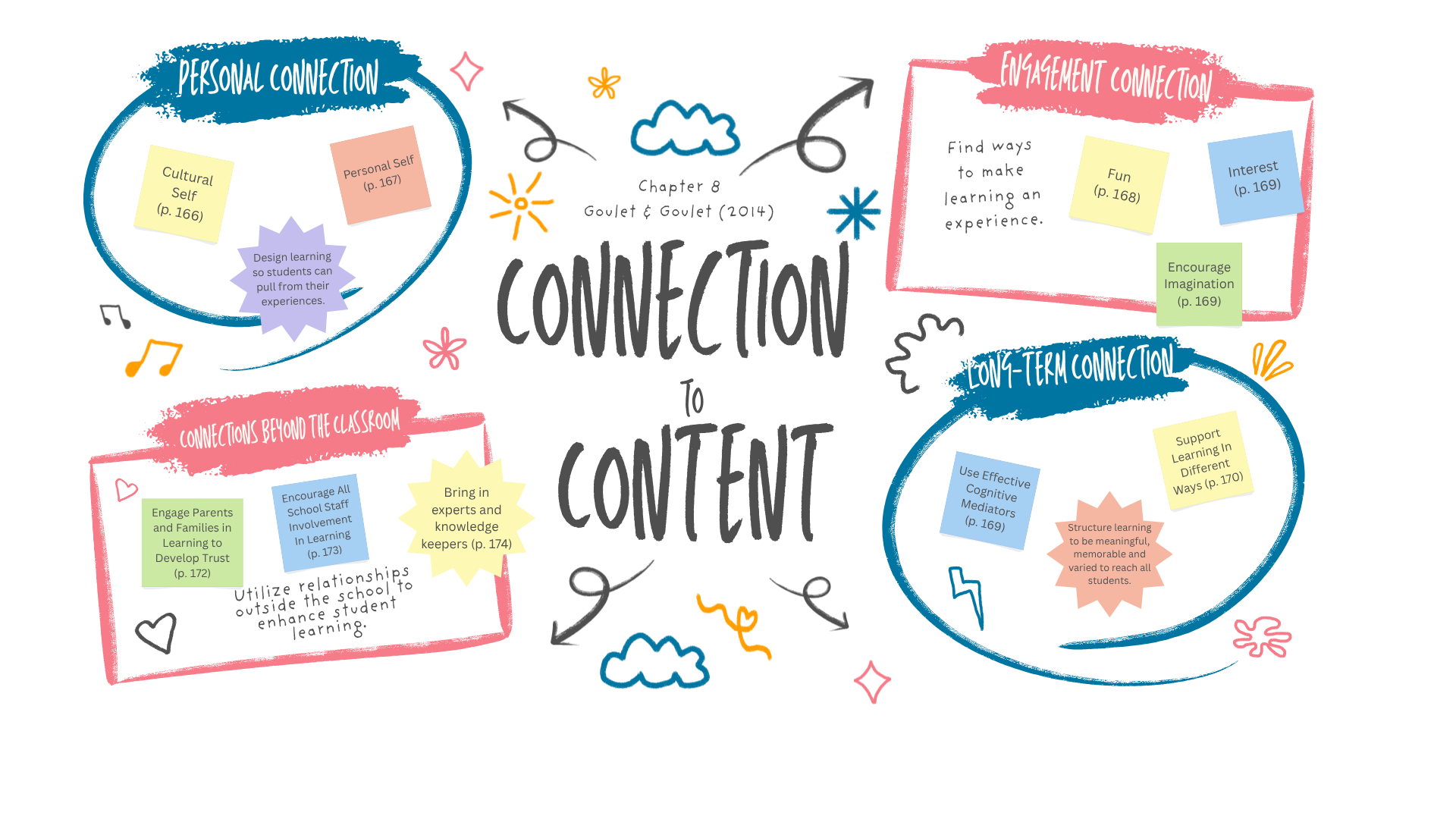
ENGAGEMENT CONNECTION: While completing my undergraduate degree, I recall hearing professors talk about the importance of making learning fun and memorable for students. The deep and over the top lessons and units that I created looked like I had an endless budget and resource bank. As I have some teaching experience under my belt, I recognize that fun and memorable learning does not always have to cost big dollars. A few years ago, a colleague of mine, asked me why I spent so much of my own money on classroom materials. I did not know that there way any other way. She opened my eyes to the power of having connections with families and the community. Instead of always purchasing resources and materials for the classroom, I now reach out to my administration, families and even community members to see if there are connections to help reduce overhead. In turn, I am opening up my classroom to the community around us.
Goulet & Goulet helped me to realize that fun and memorability often comes from knowing your students (p. 168), getting them interested in learning (p. 169), and encourage collaboration while anchoring their learning in a relatable context. I appreciate the emphasis Goulet & Goulet put on challenging students knowledge by activating their imagination (p. 169). I can relate to using imagination as the basis of many STEAM activities where students have a scenario that requires imagination and prior knowledge to problem solve and be creative. I hope to always strive to be an educator who values play, imagination and creativity as essentials for student learning.
LONG-TERM CONNECTION: As a teacher, I aspire to teach in a way that is memorable and sticks with students for years to come. From my own learning experience, I am aware that if learning is not contextualized and given meaning in ones life that the information does not make its way to long term memory. Hello read and regurgitate era! Pulling from this experience in my life, I realize that the lessons I do remember from my upbringing were hands-on or lessons that connected to my life experience. Have the privilege to guide some members of the future generation, I have a responsibility to take mandate curriculum and integrate it into students’ lives. Ideally, I will always focus on the perspective that students are developing skills and abilities in school to be healthy and productive adults. Some information that I teach is for the purpose of transmission or stepping stones for further learning. On the other hand, some topics that I teach about are fundamental for human survival. I want to go forward with the underlying ideal that completing school is not the overarching goal, but instead, we are trying to grow young minds into responsible and healthy individuals. I think this ideal sometimes gets lost in the background of the hustle and bustle of content today.
Chapter eight affirmed for me that teachers need to meet students where they are at in learning, support them and develop meaningful connections between knowledge and life experiences or cognitive mediators, as mentioned by Goulet & Goulet (p. 170). Furthermore, teachers have a responsibility to make curriculum come to life instead of being a checkbox for each year. I wonder if the current state of education means that we need to shift and update our curriculum to be focused less on memorization and set outcomes and more on practicality and life application. I believe this would help for academic learning to be more applicable and memorable long term.
CONNECTIONS BEYOND THE CLASSROOM: As I mentioned before, going forward, I would like to work on bringing families, students cultures and community members into the classroom. The ideal of building relationships with students and families through informal conversations (p. 172) and by being a community member feel attainable to me. In the past, while working in a smaller town setting, I remember the family school connections were significantly stronger than the ones I feel and experience in an urban center. I recognize the community plays a large part of this as smaller centers required people to rely on one another more. As an aspiring administrator, I seek to determine ways that encourage the small center feeling in larger urban setting. This will be an area of research for me as I continue on my teaching journey.
Connections & Takeaways
In the spirit of participation, as I was unable to attend EDL 829 class on Thursday, October 16, I returned to the activities that were shared during this time by classmates and our speaker: Risa Naytowhow, an First Nations Unviersity Advisor. Below are a few conenctions and notes that I made between these activities and the ideal of connection to content from Goulet & Goulet’s book.
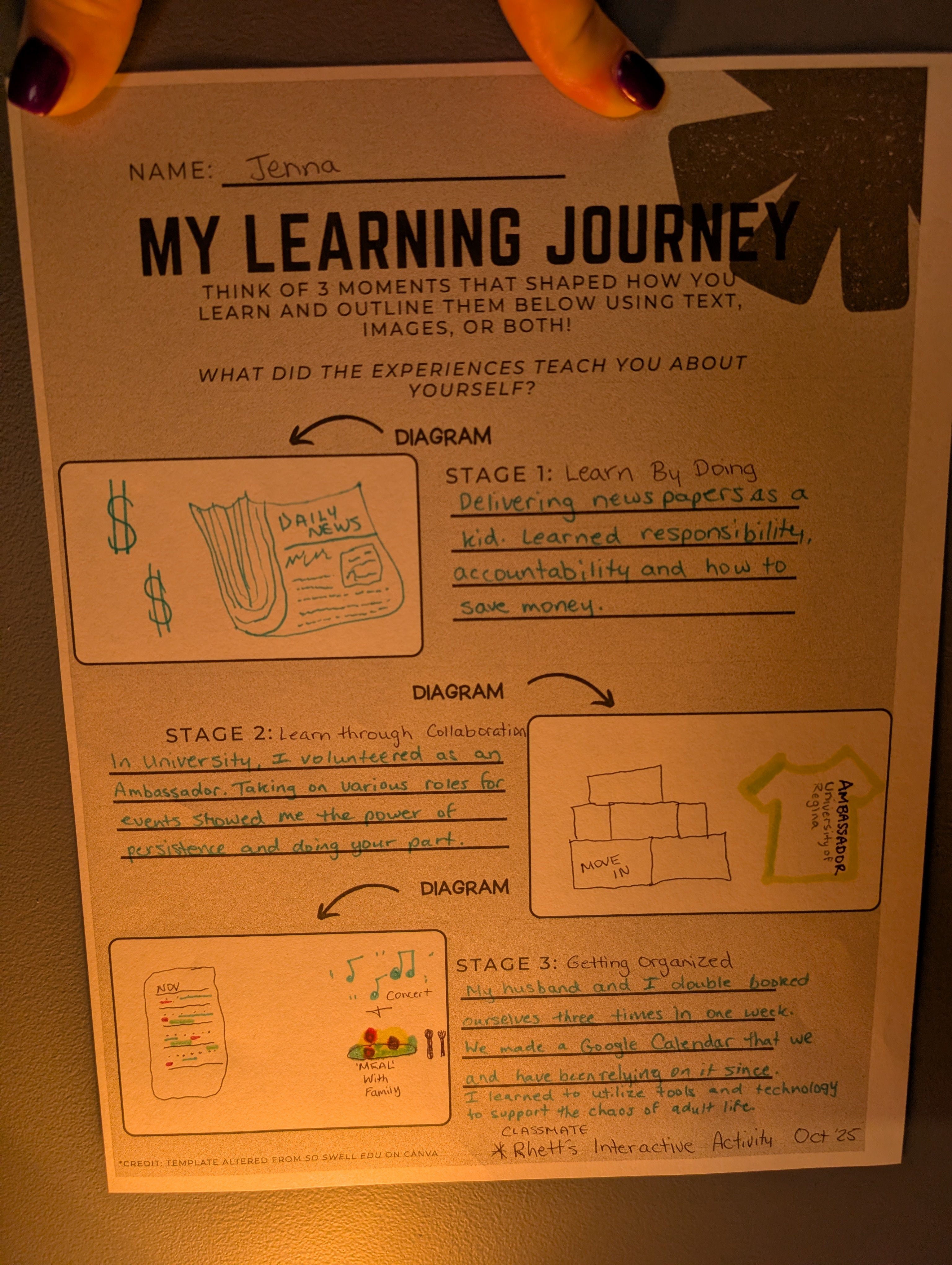
Rhett’s Learning Journey Task: Rhett designed a reflect and connect activity that I found interesting and useful. We were asked to think about 3 moments that shaped how we learn. Below, you can see my learning journey as I reflected on what helped me to become the learner that I am a today. In the classroom, I imagine adding this to my interest inventories. From it, I can learn how students learn best and some lived experience examples. This activity would help any teacher in gather information to support planning for different learning styles within the classroom (p. 171).
Risa’s Moccasin Making: Reading through this activity’s presentation, I realized that I missed out on a beautiful experience. I recognize that what I am taking away from this presentation is likely lackluster in comparison to the wealth of information I am sure was shared directly from Risa. I chose to follow the slides instructions to create a moccasin design that represented by identity or cultural background as you can see in the picture below.

This activity was intriguing to me as it supports Indigenous culture integration in the classroom and provides an a platform for traditional teachings to be shared. The conversations that would come from these designs would help to represent who students are, their backgrounds and values. The relationships that could be formed from commonalities would also be beneficial in a learning space. I connected this activity to a Metis beadwork lesson that I did with my grade five students two years ago. We listened to a podcast regarding the history and importance of Metis beadwork while creating a burlap, yarn and Perla bead flower. I believe this activity could be enhanced by seeking out someone to come in the classroom and share some teaching about Metis beadwork.
Takeaway: Altogether, I appreciated Goulet & Goulet’s chapter on connection to content. I can see that out of connection to student, connections between students, connection to process and connection to content, that connecting students to content is where I require the most work going forward. I believe that this would be an excellent personal development plan when I return to the classroom.
 The Deasent Blog
Want to add to the conversation?