

One thing that I am appreciative of, as I have participated in the masters class EDL829: Supporting Indigenous Student Success, is that as learners we had the opportunity to listen to and learn from various individuals who directly support Indigenous students or hold Indigenous Knowledge that they offered to share with our class. During our November 6th and 20th synchronous classes, we had the opportunity to listen to Roland Kaye and James (Jim) Pratt. Roland is an Elder Helper at First Nations University. Jim Pratt is a knowledge keeper and helper for the Office of the Saskatchewan Ombudsman. Both individuals shared their understanding of building relations and working with Indigenous peoples in a harmonious way. Below, I will explore some of my takeaways from these conversations and how they impact or apply to my teaching practice. To end this post, I have included my understanding, practice and plans for future regarding two activities led by my classmates Averie and Joni.
Roland Kaye
I enjoyed listening to Roland Kaye speak to our virtual class on November 6th, 2025. He shared his role as an Elder Adviser at First Nations University (FNU). He spends large amongst of time utilizing his relationships and wisdom to match professors and students with the correct elder. While Roland was speaking he shared a sentiment from an older man who wanted him to feel confident at FNU, stating that respect can take you a long way. Roland’s put my mind at ease when he mentioned that there is no right way to do things, but one must do things in a good way. I have always been concerned that when I integrate Indigenous pedagogies, that I am being disrespectful or incorrect. From this EDL829 class, our texts, and presenters, I am beginning to understand that doing things with respect and an open mind is the best method to move forward. Roland also shared that we must respect others way of life and we have a responsibility to not force our way of life onto others. I feel students should learn this teaching as they develop tolerance and understanding of one another’s differences. Personally, I need to take chances, listen and adapt so that I can grow and improve my understanding of Indigenous peoples, history, knowledge and pedagogies.
Roland shared humour and teachings with us during his 45 minute discussion. I resonated with the idea that teachings are meant to be shared so you can pull your own meaning from them. If a teaching does not serve you or connect to your life, you are to leave it to the side. These thoughts were quoted by Roland as they were shared with him from a woman elder in his life. I can see this being a teaching to share with future students and remind them that we must respect and listen to others stories and knowledge. As learners we never know what we might pull from someone’s story. Furthermore, students can develop consideration for others and practice it by sitting and listening in a respectful manner so others may connect with that story or lesson as it may pertain to their life.
My greatest takeaway from Roland’s discussion is the necessity to make connections and get to know people. As was highlighted throughout our course text: Teaching Each Other: Nehinuw Concepts & Indigenous Pedagogies (2014) by Linda and Keith Goulet, relationships are the central piece to working with all people. These relationships are especially important as an educator seeking to support Indigenous students. Going forward, I want to strengthen my relationships with Indigenous knowledge keepers, families and of course students to help make learning at school a more inviting and equitable place to be.
Jim Pratt
Reading about James (Jim) Pratt before class on the November 20th, I was impressed by his career achievement of 25 years with the Regina Police Force and another 17 years at Sask Polytech (Barnes, 2024). Jim transitioned to work as a knowledge keeper and helper for the Office of the Saskatchewan Ombudsman where he focuses on implementing and upholding acts of reconciliation that work towards decolonization in fair and just ways (Ombudsman Saskatchewan, 2015). Similar to what Roland had shared with us the week previously, Jim insisted that educators need to get to know the location first before the people. He stressed that we must move away from just stating First Nations and instead identify and connect with the local peoples, such as Cree, Nakota, Lakota, Dene and Metis peoples here in Saskatchewan. I appreciated this statement as it affirmed for me that First Nations is an umbrella term and each community and each band is different from one another. I connect this to the way educators try to view students as individuals and avoid lumping them into larger groups.
It also resonated that educators need to teach children to see the wealth in others and their ways of life. In the future, contextual learning beyond the classroom will help myself to develop understanding and relationships amongst peers. Having students go out and see relationships and connections with their classmates lives helps to build empathy and understanding, similar to Jim’s example of going to a mosque to learn about their customs.
Additionally, I connected with Jim’s idea that teachers need to physically know their students, such as what they eat and where they sleep. As educators, I feel that we have a duty to meet students needs. Pre-service Jenna did not realize that often we must support children’s basic survival needs in order for them to be ready to access their learning brain. I agree with Jim that children are entitled to their education. I do not think that teachers should be mistreated, under supported or ignored, but I know that we have a duty to meet students needs so they may learn and grow. In this post-covid era, I recognize that teachers are being asked to take on additional roles within the classroom. I hope that in the next 5-10 years that our society begins to shift in the way that teachers are valued in a higher way and provided with the adequate resources and support to meet the ever increasing needs of students.
All About Me Mandela
On November 6th, a classmate named Averie, presented her visual representation activity to encourage students to represent themselves in an art format. The all about me Mandela art piece was both informative and relaxing, as seen in the picture below.
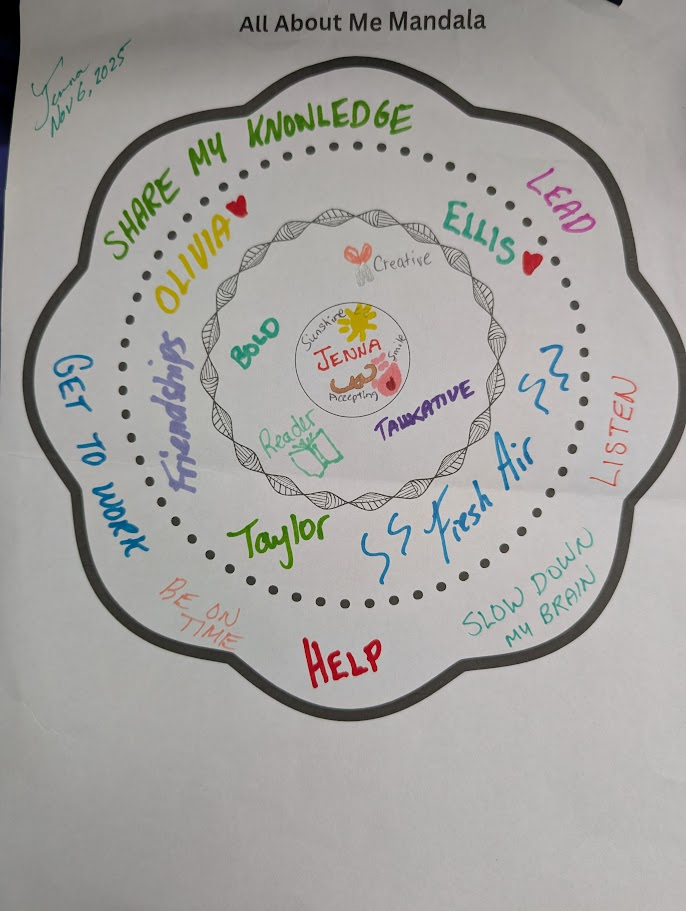
I can see this activity being used within my grade five teaching context. We discuss identity and self-esteem throughout health and English language arts. I plan to utilize this activity to give my students a open but guided method to share who they are with their classmates and myself. I enjoyed how Averie had different categories for each ring of the Mandela. I can see how these could be put together to create a class art piece. I am considering using a square in the future to put a twist on the classic class quilt art piece that I have done in the past. I appreciate that this response structure is low risk for sharing about ones self and is guided in a manner to encourage students to open up while providing a safety net of visuals or written if they do not feel comfortable to do so yet.
Mysterious Story Retell
Another classmate, Joni had the class retell a mysterious story that was shared with us in the past. Immediately, I was reminded of a story that my dad told us while camping in the Cypress Hills. The story was never exactly the same, but there were the same elements within:
- a young child was camping with their family
- they refused to listen and go to bed and stayed out eating candy
- their family warned them of the Cypress that comes late at night
- the child didn’t listen or go to bed on time
- they Cypress came, made its Cypress call and the child disappeared
- Lesson: You need to get to bed before the Cypress comes for you too
- Suddenly, you would hear the Cypress call and something touches the back of your head.
Looking back at this tale my father told us, I have fond memories of listening and then being on guard the rest of the trip for the Cypress sound. Reflecting on the story, I am not sure how I did not catch on to the story being made up each time by my dad; however, I can see my husband loving the opportunity in the future to use this cautionary tale to help our kids go to bed on time while we are camping.
I thoroughly enjoyed having an opportunity to retell this story to some adults and get out some giggles too. From a teacher perspective, I can see how retelling stories can be a powerful tool for students to share their understanding of a message with others. Relating to my own experiences, it is a form of art to be able to craft or retell a captivating story. Intentional pausing, stresses and tone of voice are skills that take time to master. I can see myself utilizing Joni’s mystery story retell activity as a way to engage my grade five students in our mystery unit. I think that this would be an excellent way to get students thinking about what they know about the genre of mystery, examples that they have heard of and when you are ready, they could utilize their own stories to analyze the structures and elements of a mystery. Going forward, I would like to find more ways to use storytelling as a method of idea generation, knowledge sharing and not always just a way to wrap up.
Conclusion
As I reflect on the discussions, activities and presentations from this term, I feel fortunate. It was a privilege to listen and learn with and from so many different voices and perspectives. I hope that as I continue along my learning journey that I always seek to listen and understand first. Our presentations from various leaders and elders was heart warming and thought-provoking. I want to go forward in life seeking to develop relationships with people who have different life experiences than myself so I can always learn and grow. I can see the wealth and power that this class, EDL829: Supporting Indigenous Student Success has for the next generation of leaders in the education world. I plan to continue my journey of learning about implement Indigenous pedagogies as well as push myself to take action, even if it is messy. For now, I thank you for taking the time to listen to my words and thoughts as I navigate new learnings and connections.
Until next time,
Jenna ❤
References
Barnes, V. G. (2024, November 13). Jim Pratt – the Knowledge Keeper/Helper for the Office of the Saskatchewan Ombudsman – Prince Albert Daily Herald. Prince Albert Daily Herald – Prince Albert’s Only Locally-Owned Daily Newspaper. https://paherald.sk.ca/jim-pratt-the-knowledge-keeper-helper-for-the-office-of-the-saskatchewan-ombudsman/
Goulet, L. M., & Goulet, K. N. (2014). Teaching Each Other. UBC Press.
Ombudsman Saskatchewan. (2015). Welcome to James (Jim) Pratt, Knowledge Keeper/Carrier and Elders’ Helper – Ombudsman. Ombudsman.sk.ca. https://ombudsman.sk.ca/news/2024/2024-07-29/welcome-to-james-jim-pratt-knowledge-keeper-carrier-and-elders-helper/
 The Deasent Blog
Want to add to the conversation?