
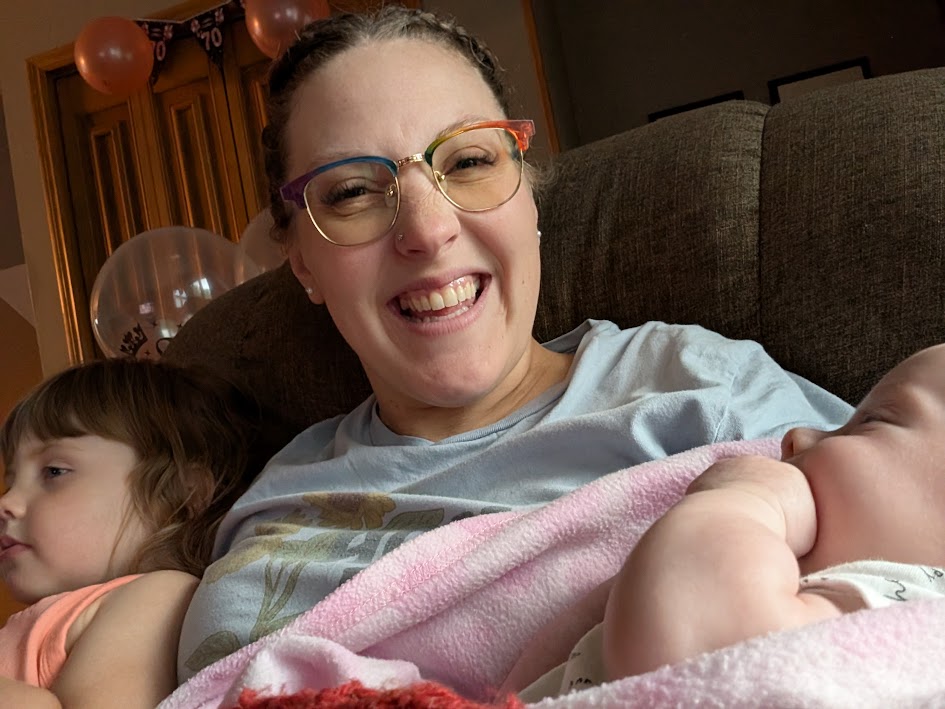
Let me introduce myself. Hi, I am Jenna! In my life, I take on various roles: wife, mom, daughter, friend, teacher, crafter, dancer, singer, jokester, and Disney enthusiast. I am originally from a small town in the North-East corner of Saskatchewan. I currently live in Saskatchewan and Alberta’s border city. This school year, I am on maternity leave after the birth of my second kiddo this spring. Before maternity leave, I spent the last 2 years thriving as a grade 5 teacher.
My professional classroom journey started during my education degree at the U of R, followed by my first year of teaching in Nipawin. My year there showed me the power of relationships with students and families. This has inspired me to always put relationships first, in my classroom and professional interactions, as I have seen the power that they yield. In my 7 years of teaching, I have taught grades 1-6.
Beyond school, I love crafting and being creative. I am a lover of Disney films and have enjoyed sharing these cherished movies with my 3-year-old daughter. I am on my 6th course in my Master’s of Teaching, Learning, and Leadership. My professional goal is to work towards an administrative role one day.
Exploring the first few chapters of Linda M. Goulet and Keith N. Goulet’s book Teaching Each Other: Nehinuw Concepts & Indigenous Pedagogies (2014) sparked some reflection on my upbringing and experiences in life and teaching. I greatly appreciate that this text is set in a Saskatchewan context, as it brings an authentic and relevant perspective for someone living in this province.
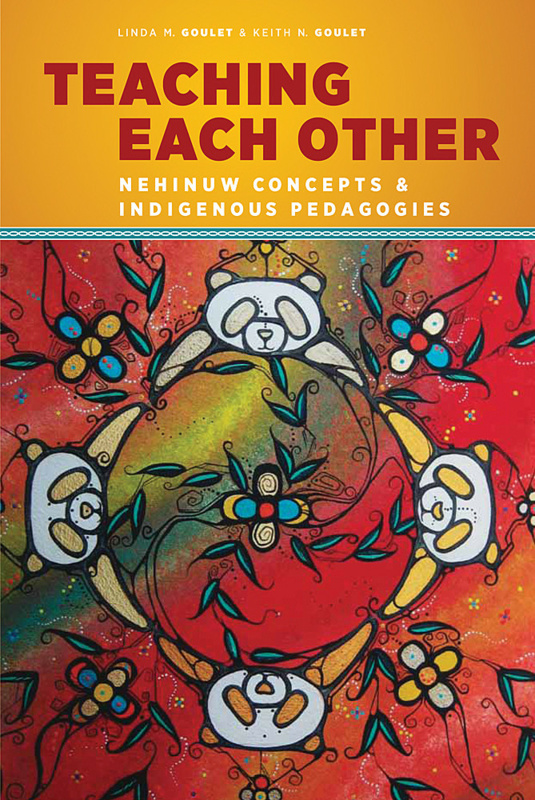
https://www.ubcpress.ca/teaching-each-other
My Roots & Schooling
I connected with Linda’s background growing up in a community where you were “immersed in the racist ideology regarding Indigenous peoples in Saskatchewan” (p. 6), where, like Linda, I developed “non-critical racialized notions of Indigenous peoples” (p. 6). who did not live in my community. I recall connecting with Indigenous classmates during schooling, but hearing and seeing racism and ignorance play out in the community daily. Growing up in this environment, I did not realize the issue of these comments and attitudes towards Indigenous peoples until I took an Indigenous studies class in grade 12. While reading case studies regarding Indigenous land claims and, for the first time, being taught about the embedded racism that exists in Canadian society, I began to grow concerned about my past. As I left my small town and moved to Regina to complete my education degree, I felt a weight in my early classes, realizing the unlearning and personal work that I needed to do to counter my racist upbringing.
Through my education degree, I spent a lot of time learning about the history of Indigenous and European peoples in Canada. My learning was supplemented by attending a pipe ceremony and experiencing, as well as learning to facilitate, the Kairos Blanket Exercis,e as well as presenting at the Witness Blanket display. Along this journey, my personal experiences, learning, and unlearning in many ways challenged my preconceived understandings of the colonial history of Canada. I continue to push myself to learn and unlearn in hopes of reducing my ignorance as a white middle-class woman.
NIPAWIN
My awareness and appreciation for Indigenous cultures continued to grow as I entered my first year of teaching. As mentioned previously, I started my career in Nipawin, teaching grade 6. The emphasis on relationships was a key takeaway for me from that year. While reading the first two chapters in Goulet & Goulet’s (2014) book, I made various connections back to my year in North-East Saskatchewan.
First, I appreciate how Goulet & Goulet call classrooms a “microcosm of the broader community and society” (p.27). My first year teaching and the relationships I built in this community exemplified the statement that classrooms are microcosms. Encountering scenarios in the classroom with blatant prejudice and then observing a similar situation out on the streets of the community was astonishing. I recall meeting families who shared strong political opinions, which were complemented by rhetoric from their child’s mouth on the playground. Making this connection to the Teaching Each Other text reminds me of the old saying, “the apple doesn’t fall far from the tree,” which has been relevant to my teaching experience so far.
As I mentioned, relationships were the core idea that I took away from my year in Nipawin. I was in awe of how my colleagues strived to get to know students and their families. The school that I was at received a grant to support student attendance. A teacher was hired, or more accurately, relocated in the school, to focus on supporting school-home relationships. This included calling families in the morning if a student was not at school, driving over to their home, and providing a ride to school if necessary. The attendance rate was phenomenal at this school with close to 100%. A beautiful side to this was that families, specifically low-income families, knew that if their child missed the bus for some reason, an adult at the school cared enough to find a way to ensure that they made it to school.
Goulet & Goulet shared the idea that as graduation rates increase, there is a correlation to a decrease in unemployment (p. 4). Reading this chapter helped me to realize that relationships with families go far beyond the walls of the school and have a lasting impact on people’s lives after school. Being curious and open to what others are going through and the community they are a part of is an essential way to ensure that students feel seen and valued. When students feel like they belong, they are more likely to want to be at school. Furthermore, it is incredibly hard for students to achieve a formal education if they do not attend school in the first place. I can see what Goulet & Goulet meant that higher graduation rates correlate to lower unemployment, as a high school diploma is the bare minimum for most minimum wage jobs today.
Settling In
When I left Nipawin, I told myself I would focus on solid relationships with families and the students in my classroom. Funny thing about this is that moving from a relatively small center to a city means that the context of your school has changed, and in many ways, this impacts your relationships too. I have had strong relationships with families in my classroom previously; however, I was told point-blank that out-of-school meetings and home visits were not done in our community. I realized that in this new area, the school community was not used to the ‘out of the school’ method for developing and strengthening relationships that I had seen at my previous school. A few years have passed, and in my current school, I feel comfortable taking part in home visits, when needed, and I always offer to meet families in or out of the school, depending on their comfort level with the institution. These transitions took time, and I needed to get used to the community and establish myself as a member of the school community, too.
Going Forward
Some key takeaways from chapters 1 and 2 of Teaching Each Other include continuing to put relationships in the forefront of my teaching methods. I would like to spend time tailoring my curriculum to better suit my students and, as the story of Anne Dorion mentions, use curriculum “to teach students about themselves” (p.28). I am starting to realize that curriculum is only a tool that helps students to uncover what they are passionate about, skilled at doing, and what they strive to improve upon. As an educator, my job is to contextualize learning to make it authentic for my students (p. 16). Furthermore, if I aspire to be an equitable teacher, I need to focus on teaching the student first by supporting them where they are at, and following up with academic. Finding innovative ways to do this in the confines of our K-12 public school system in Saskatchewan will be a challenge, but it is possible.
To end my post today, here are a few areas of further growth that I would like to discuss more in future posts that were brought up while I read chapters 1 & 2.
- My Critical Lens: How much do I know about the colonial history of Canada and the evolution of the European-Indigenous interactions? What am I missing? What role can I play in countering colonial narratives in my classroom?
- Outdoor Learning: How can I design and implement more outdoor and land-based learning opportunities in my classroom?
- Whiteness: What role does whiteness play in my classroom? In my teaching experience? In my school? What are some ways that I can raise up the voices, stories, and cultures of others?
References
Canadian Museum of Human Rights. (2022). Explore the Blanket | The Witness Blanket. Witnessblanket.ca. https://witnessblanket.ca/explore
Goulet, L. M., & Goulet, K. N. (2014). Teaching Each Other. UBC Press.
Kairos Blanket Exercise. (2025). Kairosblanketexercise.org; Kairos Canada. https://kairosblanketexercise.org/
 The Deasent Blog
Want to add to the conversation?